-
Some Passing Thoughts
If one meditates on the passages of The Bible, particularly those words printed in redletter, soon enough one comes to clarity about what the human project is about, why we suffer, and what must be done about it.
Most political philosophies require one to stand either on the side of utilitarianism or egalitarianism; there is always some sort of loss of either collectivity or individuation when leaning on one dialectic position or another.
But Jesus, who is called the mediator, the Great High Priest, stands central upon the fulcrum, at once bringing the divine, the heavenly, to the earth, and raising our physical reality to a higher realm of the spiritual. The function of the priest in all religion is precisely to occupy the hyphenated space—sacrifice is brought to God through the priest, the Eternal God dwells on Earth where the priest is present.
The reason Christian faith is dangerous to modernity is precisely for this reason. Authority is not derived from law, rationality, or even reason; authority comes solely from relationship (versus a word spoken, or an authority prescribed) to the Christ, propitiation and mediator, transcending all the human structures of politic, philosophy, identity, and all associated logics. The logic of Christian belief is simultaneously pre-logical and post-, not even time or history can contain its simultaneous bareness and infinitude.
It is never any wonder why those who hold authority, that is to deem what is right, what is wrong, who belongs where and for what reason (these are the fundamental questions of government), discount true Christian belief as backwards, regressive, morally corrupt, for under the authority of Heaven, all men fall short of the glory of God, that is to say, equality is unanimous and authority belongs to no one except God.
It maybe can be assumed that I do not agree with self-identified anarchists on many philosophical and political points, but what I respect and believe should be hoisted is a deep mistrust of human institutions, those halls of power which are guided neither by an individual sense of altruism, nor by belief in a world beyond worlds. I possess too much belief in obedience to ever fully prescribe to the naturally rebellious tendency of anarchism, but still yet, defiance of hegemony derived for the sake of class-preservation is something that Jesus implicitly encourages (by my interpretation) in his dealings with the religious elite of his time.
And maybe more controversially, given my own political leanings, I see the same spirit in the free-market capitalist, though I hotly detest their avoidance of the need to constrain resource and power to what is available without exploitation. There is an undercurrent of good rebellion, distrust of government, springing across all classes, all people, who’ve awoken to the fact that their participation in the games of the political elite do very little to benefit the reality they must live everyday. As it stands, political economy, specifically that of America, is nothing more than a rebranded celebrity culture, where personality and identity matter more than policy—one can say such and such politician is good or bad, but the truth is they all vote in unanimity to prop up trillions of dollars in the American war machine, of that virtually all politicians operating at a federal level are in one accord. There is nothing citizens can say or do to prevent their complicity in American wars of aggression, whether through direct occupation or by proxy via supply, and in that regard, we are citizens only in that we get to choose a team or a celebrity to root for that will add their name to the bills authorizing destruction of democracies, entire groups of people, authorize soft-colonization via American military presence abroad. In reality, we are not citizens at all, but a class of peons, prescribed to the service of nation-state.
This is not to mention the neoliberal economic order wherein all global powers pretend to be in contention with another, but are quick to authorize and agree to profitable terms of trade behind closed doors, deciding which nations, which peoples should have access to the excess capital generated by unfettered consumption. This is too complex of a topic to sum up in brief terms, but to even consider the cost—labor, carbon emissions, generation of margin—of every good, every product in your immediate view should send a chill down one’s spine.
To return to my initial train of thought, yes, I have many disagreements with many vertices within the political spectrum, but the most dangerous, those that must be spotlighted for their vapid, individualistic beliefs are those who are willingly upholding the current institutions of power, the current political order, where the only winners are those who say “Yes,” never with the courage to deny the self for another, abdicate some level of personal liberty for the better of their neighbor. One may be tempted to see American politics as liberal versus republican, but the real truth is that it is all one party of elite libertarians, vying for a seat of power to maintain their own sense of control, impose their own morality, correct the radical discourses to obey authority at the cost of the individual. When you feel a fervency to vote for your favorite celebrity politician, cheer for your political team, always remember, they do not care if you live or die, unless support for your story will garner more votes come election time. I have recently finished reading some Baldwin I’ve meant to read for some time now, and what he says of the judiciary is completely accurate, and even contemporaneously true, that whether justice has been served to some and not been served to others, the entire system is guilty for its treason against the most oppressed, for siding with the most oppressive, the most powerful, the most ignorant, the status quo. Nothing should resolve the system of its guilt, not a small political victory or new decree, which is as easily overturned as it is instated, which is as easily rebranded as it is denied. Look at landmark cases from the Civil Rights Movement, which exist in canon law and are widely accepted as necessary, and tell me with a straight face that racism has been all but eradicated. Progress is progress, until they say ‘It’s gone too far,’ those with real power threatened by the encroaching consciousness of doubt. Anything to protect comfort, separation from real human suffering. It is all farce from rank to rank, and your time and energy is better spent studying, learning, considering what schools of morals you really believe, no matter how radical.
Sincerely yours,
– -
Against Liberalism
So then, because you are lukewarm, and neither cold nor hot, I will vomit you out of My mouth.
Revelation 3:16 NKJVI’ve spent a lot of the past year writing in another language: sweet, emotive language. But there are certain topics that deserve discussion, topics which must be put to rigorous questioning. No niceties, no carefully crafted rhetoric, no manipulative shows of identity.
Namely, I’d like to discuss the state of American liberalism, which I have in the past called a disease, an opinion I still hold but can’t find a more empathetic term for. I don’t have the dexterity of my peers to cite exact sources of my knowledge; my reading habits are as sporadic and schizophrenic as the manner and rhythm I make these kinds of statements.
But the claim I make today is not a new one, it has been spoken of by writers, philosophers, leaders, politicians, and even businesspeople for decades, albeit in muted tones so as to not ring up their own names for the blacklist lottery. The claim I make is that American liberalism is a failed project and must be consciously deconstructed. This is a point that even those who consider themselves my political opposites agree upon, that the feeling of progress through unregulated and unfettered capitalism, the endless hunger for expansion and growth in a zero-sum game, has only deepened the very crises the liberal-center aims to eliminate. What has happened is that anyone who sees this reality—that poverty is rampant in the wealthiest epicenters of our society, that subjective, individual morality has only strengthened a few of the privileged, educated class—anyone who sees this reality and approaches it with shame, disgust, sadness at what this country has become is immediately labeled as an enemy, someone who doesn’t believe in the same conception of ‘freedom,’ rarely critically considered except for what it means in the individual sense.
The argument is that if only so-and-so liberal leaders held all the power of government then we would live in utopia—an endless flow of capital would heal the broken parts of our society, new non-profits and government agencies would finally fix the preexisting ails that cause poverty and homelessness. Besides the obvious points of why augmenting bureaucracies into an already massively sprawling bureaucratic militarized security state would not fix any problems, it is clear that most who support this sort of ‘let the government handle it’ attitude towards government is exactly the sort of political philosophy, and even political science, that drives what they believe to be the enemy of liberalism, that is left-wing historical materialism, right-wing nationalism. Liberalism is confused about who is an enemy because its flexibility, lack of philosophical backbone, allows it to be reflexed towards whatever is most convenient, what causes the least disruption in what they perceive is ‘the best we can do.’ It is not the angry left-wing that is cynical, nor the tempered right-wing that seeks a return to functional, moral government; it is the liberal-center that expresses the most contempt for their fellow human, believing that only the well-educated, well-learned, well-employed, well-adjusted are suited to know what is best for them. This is not to mention that, in my experience, most people who identify as progressive or liberal tend to know the least about the history of the political ideology they purport is the only suitable form of governance in our country.
If one reaches far back enough, beginning with the Industrial Revolution and traces lineage to the present, we begin with the amelioration of the lowest classes of labor, namely that of slave and immigrant labor, into the industrial economy. All this project was, simply named, is a rebranded, polished colonial ideology, that great wealth can be amassed from the hyper-productive labor of those most in need of access to the larger economy—newly freed slaves, East and South Asian immigrants, and those at our borderlands who saw greater opportunity in the unclaimed fortune that lied in the wake of a technological revolution. Decades have scrubbed this project clean of its origins, the proof is said to be in the rapid modernization of the country, the proof is said to be in how happy citizens are, the proof is said to be in the global domination of Western liberalism in the world forum. In each of these points, I concede that the country has succeeded, but wholly absent is the cost. The wars of aggression, the colonial expansion and domination through military might, the economic domination in global trade, the quiet truce with nations that agree to manufacture our utopian global capitalist lifestyle (which is always betrayed by the public declarations that such-and-such a country is an enemy to our ‘freedoms’). The goal of liberalism is to hide this expensive cost of freedom, to make everyone feel good about signing onto an agenda they know little about, touting personal freedom as the true measure of progress. I confess, I care very little for this brand of freedom; it is an ideology that says free speech must be protected at all costs, unless the speaker is from the left- or right-wing. It is an ideology that says preservation of one’s sense of self is a higher good than that of an entire group. It is an ideology that allows people to give rankings and judgments of deservedness based on the feelings, affects of a few, rather than material reality. If the liberal agenda of placation, non-disruption, palliative measures is to advance to total political domination, what we will have is not a utopian society of peace and ever-extending tolerance, no, it will be the opposite. An impossibly widened gap between classes, where one is blinded to the plights of those below, and the blame is assigned to the fact that they didn’t sign onto the program. This is reminiscent of the exact political movements in history that liberals cry as oppressive and worthy of damnation, the project of national socialism in reconstructing Germany, the empire of the Soviet Union, managed by its many bureaucracies and rules of moral behavior. The problem with the liberal conception of freedom is that it never equates to liberty. One is allowed certain forbearances regarding their identity, sexuality, belonging, religion, family structure, whatever etcetera, but remains enslaved to the economic model of pre-industrial capitalism, now to the point where surplus value can be extracted from businesses of thought—media, social networking, advertising. The point is to feel good without ever seeing the true cost, the underpaid labor overseas, the massive amounts of waste produced by our consumptive habits (look at carbon emissions per capita and the U.S. is always at the top, only China comes anywhere close, and we must consider how much of this is a byproduct of the production of goods and materials for the West), the economic and political alienation of those we call fellow citizens for their ‘wrong belief.’ The reality is, anyone who is outspoken about the ills of the liberal project of global capitalism is put to asylum, placed into a category of political death, marked for deletion from the commons of opinion. This is especially easy to accomplish in the digital age, as information—whether true or pure libel—can be disseminated in an instant upon any masthead that is signed on to the project.
I will not even touch on the fact that many of the government programs that liberals tout as successful were the brainchildren of Socialists and Communists, a fact easily obscured through association to the Democratic party. Let me be quick to remind you that many celebrated national heroes belonged to the socialists—Martin Luther King Jr., Susan B. Anthony, Helen Keller, Henry Wallace. The liberal argument that socialism and communism has failed in every historical instance denies its own logic upon self-examination, that the Democratic party was a bulwark to protect slaveowners, that the party adopted platform points from the Socialist Parties because they knew they were popular demands from a great majority of citizens. This is not to say that platforms and parties do not change or evolve, but to point out that the same grace is never afforded to any ideology which directly opposes the individualist, hyper-consumptive neoliberalism which currently haunts our present, glooms menacingly over our future.
From James Baldwin’s No Name in the Streets:
“For intellectual activity, according to me, is, and must be, disinterested—the truth is a two-edged sword—and if one is not willing to be pierced by that sword, even to the extreme of dying on it, then all of one’s intellectual activity is a masturbatory delusion and a wicked and dangerous fraud.”Sincerely yours,
– -
On Inspiration
In most creative pursuits, inspiration is touted as the necessary starting point for synthesizing anything with meaning. I subscribe to this belief, but argue that inspiration must guide the entire process of creation. The fallacy of exclusively tying inspiration to the earliest segments of the creative process lies in the fact that everything generated by the self is in actuality a product of exterior influences, tenuously jointed by one’s experience of life. Once you feel the electricity of inspiration, it’s easy to chase the vectors of this feeling towards an idealized outcome, paying no attention to anything but the lightning you’ve managed to catch in a bottle. This, to me, is too linear of a sequence to garner any sort of creative merit. My thinking here is twofold:
- Lack of humanity: Anything that can be produced algorithmically without human intervention (judgment, input, curation) is not generative but merely iterative, mashing preexisting data into output.
- Too dependent on chance: Waiting for inspiration to arrive is like standing on a river bank hoping the water will carry gold directly to your feet — such a phenomenon is certainly possible, but even if it happens, it’s unlikely to be in any quantity that will satisfy the desire to strike it rich on the gold bar.
An initial rush of inspiration can fruitfully guide a creative process. But as time passes and the electricity is no longer present, inspiration becomes a datapoint, pulling threads from the current moment to a historical serendipity that can’t be reproduced. Hanging onto that specific instance of serendipity will generate a product that’s permanently tied to artifacts of the past rather than something that forms new connective tissues and expands (read, liberates) a preexisting concept from its theoretical bounds.
In my personal creative practice, I find it far more enriching to gather inspiration at multiple points of reflexion, revising formerly established patterns of thinking and anticipating a wider variety of future outcomes, rinse and repeat. This supplants a positive feedback loop wherein curiosity not only carries but amplifies the creative impulse with multi-dimensional connectivity between disparate sources of wisdom. Because everyone’s experience of life is unique to themselves, within every individual there are some tensions that can only be expressed by said individual. When we relate to others’ stories, we aren’t relating to their story in full — in reality, we might only understand a certain percentage of the thoughts/experiences/concepts that formulated a presented narrative. Yet we see in literature, film, music, visual arts an endless schematic of derivations that thrust open all preconceived notions of the world by merely incorporating fractional understanding, reinvigorating the entire discourse with a uniquely human perspective. If one creates from their personal experience, there’s no risk of presenting something duplicative, unless they’ve lived another’s life step-for-step. And even in such an instance, the human psyche exists in the flux of increasing biological diversity and ever-changing environments; there is no guarantee that a shared physical reality will constitute identical patterns of thought between two individuals.

One of the most frightening aspects of inspiration is that we are intentionally leading ourselves into the unknown — the end result will often look entirely different than what was imagined before beginning the process. But really, what does it mean to be human except to overcome this fear of the unknown, to seek certainty where none exists, making meaning along the way. I feel that everyone’s had this sort of watershed moment at some point in their life, facing a new revelation and grappling with all the contradiction that would spring from submitting to an entirely new set of facts. But without this struggle against primal fear, we will eventually succumb to safe decisions that do nothing to challenge or enhance our current understanding of the world, and maybe more worryingly, we’ll reiterate the facets of history that formed our present dystopia. There’s definitely a place for ‘safe’ inspiration; the corporate workplace is the perfect arena for risk-averse exploration. Analogs, competitive reports, 1:1 replication; all of these are useful devices where agreement must be efficient rather than perfect.
However, when the purpose of a creative pursuit is to reorient significance and meaning, it’s vital to consider all nuance in proper proportion — leave no stone unturned, so to speak. Thoroughly considered work will always contain visible traces of inspiration, shown in both depth and width. One theoretical concept that I feel clearly illustrates how inspiration manifests itself is Foucault’s concept of discursive formation. At any given moment in time, if we are to slice a coin from the “sausage” of history, we should find within the circle all the components that make up the whole “sausage.”
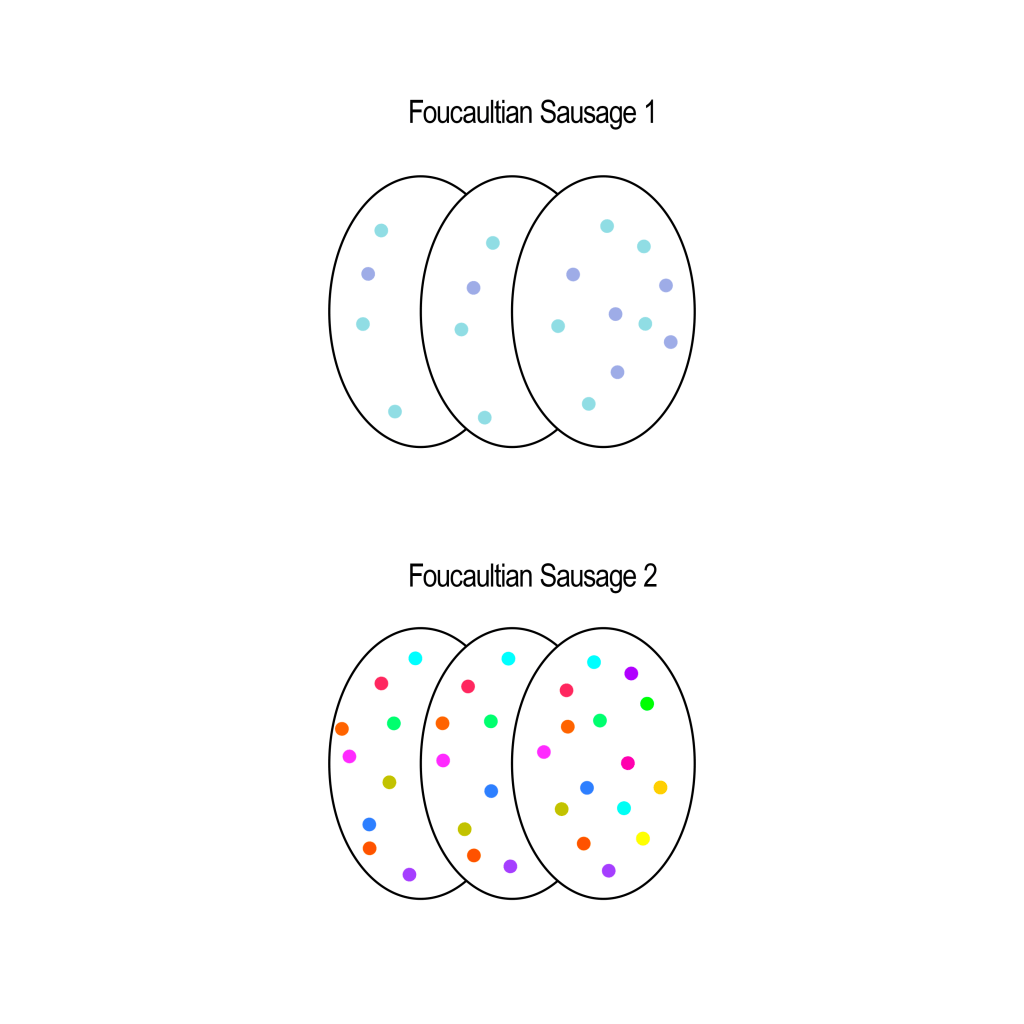
Within each coin is a cross-section of time possessing a unique ratio of discursive ingredients and positional variance. Forgive me for continuing the “sausage” metaphor, but if we are to imagine taste (aesthetic, affective, or otherwise), a casing containing a multiplicity of discursive sources will typically produce a more complex relationship between components, thus a more complex/nuanced flavor, than a casing that contains one or two ingredients.
Tradition often demands a narrow selection of historical discourses, but in the era of the internet, we are confronted with the specter of simultaneity; history, current events, and futurism are all competing for authority in the realm of knowledge. Against the backdrop of postmodern cacophony, tradition offers a simple, linear understanding of the world and its progression into the future — truth can be understood as a fact, tied to specific people, places, and times. In contrast, what postmodernism gives us is an unconscionable truth, that is, a truth that remains in a dynamic state, wholly dependent on the flow of society’s undercurrents.
The consequence of a truth that cannot be grasped by discourse (because veracity depends on which discourse holds current authority) is metaphysical violence between historical reality and a sort of quantum unreality, where phenomena are released from the constraints of time and generate an overall impression or affect rather than an empirical truth. For this reason, I call postmodern truth unconscionable; instinctively, our conscious minds are prisoners of instinct, obeying naturalistic laws of energy, entropy, survival, etc. A postmodern truth thus threatens every known basis of reality, from physics to neuroscience. I believe it’s in this threatened state that we as humans possess our most powerful creative capacity, negotiating the distance between reality and unreality by connecting discourses into amalgamations of various truths. This isn’t to say that there’s complete unity or certainty in these formations of truth “modules,” but rather there simply exists an expression of truth in the interconnection of things.
Take for instance, dreams. Dreams do not constitute our material reality, yet they are true representations of the unconscious mind, reflecting some aspect of our experienced, physical world through signs. In dreams, all impossible things are possible, such as bodily flight, infinite architectures — things like never-ending hallways, gravity defying constructions. But these impossible phenomena cannot be categorized as true or untrue; they are simply unconscious symbols of one’s relationship with reality, from which a profound truth may be derived. The extracted truth could possess a universality, however this can never be proven by examining the sum of its parts or even the relationship between parts, for as I’ve hypothesized, our psyches are dynamically linked to the flux of language, what I posit is our primary tool for analyzing and synthesizing knowledge.
To return to the topic of inspiration, the profundity of one’s creative output is reliant on its expressed truth — all art should invite relation to itself, transporting the observer to an unconscious, metonymic realm via a physical phenomenon. The greater the interconnectedness and multiplicity of truths, the more opportunities exist for an observer to relate to a work of art. It’s for this reason we admire the works of classicists; the intense focus on divinity as an artistic subject gives us an infinite wealth of interpretation, even into a time when atheism reigns as a dominant ideology. Conversely, the output of AI-generated art, if traced to its most fundamental components, can only exist as a series of binary decisions which might draw from multiple sources of inspiration, but loses connectivity between ideas as binary decisions scale up into a final product. Truly inspired art instead seeks to express the tenuous connections between disparate inspirations, synthesizing thought beyond its creation.
I could say more on this topic, but I want to save some of my insights for other topics. Might write a second part to this, if I ever feel inspired enough.
Sincerely yours,
– -
On Anything
In the war of haves and have-nots, what tends to get lost is documentation of mid-cult; an explosion of the cultural fringe that renegotiates the boundaries of both sides. I’m tempted to write with flourish and polish on a subject like this, but attending to mid-cult demands the opposite.
In ideological contests between opposing forces, the main site of struggle is for definition. This struggle plays out in various arenas — abstract/real, local/global, utility/equality, intrinsic/extrinsic, etc. — philosophical battlegrounds that produce the proofs we use to make sense of the chaos of daily life. But without the buffer of mid-cult, these ideological contentions can only generate endless loops of power, revolutionizing information too quickly for any staying change to take hold. Without mid-cult present in cultural conversation, all aspects of culture are reduced to a game of heuristics and majorities, stripping the common of all subjectivity and expression for the sake of winning numbers.
It doesn’t take much to imagine the disaster of culture defined by probabilities and statistics; we are already living through this dystopia. Whatever we love in life — whether things, ideas, or even people — can almost certainly be traced back to consumer behavior and images forced on us by a controlled flow of information. The role of mid-cult, in my view, is twofold:
- Generatively analytic
- Tactically subversive
In simpler terms, mid-cult 1. draws careful connections between ideologies and 2. expands definition while out of view. What I mean by out of view is that mid-cult is almost never presented as a tangible entity; ideological wars are always shifting, and mid-cult by nature remains in the same dynamic state. Optimally, mid-cult should take the form of cultural observation, extracting the psychic principles made available by analysis of the real, material world.
Eventually, as the apparatus of mid-cult dissects ideologies into a complex network of nuances, we should be able to see representations for what they are — representations — rather than absolute truth. Every war, physical, psychic, or otherwise, is waged on the inherent truth of language and laying claim to this or that definition. In my diagnosis of today’s ideological landscape, the only way toward peace is to disrupt the notion that language bears any sort of neutral truth; sowing doubt will produce good questions, and all that is true can withstand questions.
Polemics belong in the conversation of what culture is and should be. Without it, all we’ll hear on our climate-fueled death march is advertising.
Sincerely yours,
–
-
Subscribe
Subscribed
Already have a WordPress.com account? Log in now.
 midcult